Investigating ionising sources and the complex interstellar medium of GHZ2 at z = 12.3
Apr 9, 2026·,,,,,,,,,,,,,,,,,,, ,,,,,,,,,·
0 min read
Marco Castellano
Lorenzo Napolitano
Bianca Moreschini
Antonello Calabrò
Lise Christensen
Mario Llerena
Thomas J. L. C. Bakx
Franceso Belfiore
Davide Bevacqua
Mark Dickinson
Adriano Fontana
Giovanni Gandolfi
Tommaso Gasparetto
Alessandro Marconi
Sara Mascia
Emiliano Merlin
Takahiro Morishita
Themiya Nanayakkara
Diego Paris
Laura Pentericci
Dr. Borja Pérez-Díaz
Guido Roberts-Borsani
Sofia R. Ruiz
Paola Santini
Tommaso L. Treu
Eros Vanzella
Benedetta Vulcani
Xin Wang
Ilsang Yoon
Jorge Zavala
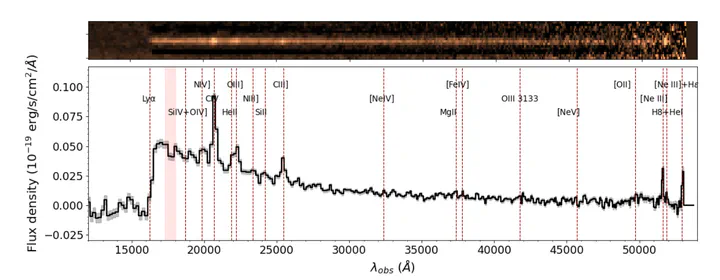 2D and extracted 1D JWST/NIRSpec PRISM/CLEAR spectrum of GHZ2.
Abstract
An accurate characterisation of the physical properties of galaxies at cosmic dawn is key to understanding the origin of the high abundance of UV-bright galaxies at z~10. We exploit deep NIRSpec PRISM observations of GHZ2 to constrain the sources of ionising radiation and the properties of the ISM in this bright, compact, and highly ionising galaxy at z=12.3. We measure with high significance the prominent NIV, CIV, HeII, OIII, CIII, OII, and NeIII emission features previously detected in shallower observations, and confirm the detection of the NIII]l1750 multiplet, yielding tight constraints on the N/O ratio, which is found to be ~2 times the solar value. We also detect the MgIIl2800, [Fe IV]l2833 and SiIIl1812 doublets, the H8+HeIl3889 blend, and the SiIV+OIV]l1400 absorption complex. The OIIIl3133 fluorescence line is only detected in the first observing epoch, implying variability on a rest-frame time span of 19 days, strongly suggesting the presence of an active nucleus. Combining the NIRSpec dataset with available optical and far-infrared constraints from MIRI and ALMA, we show that the emission spectrum of GHZ2 cannot be reproduced by single-density spectro- photometric models. Multi-zone photoionisation modelling performed with the HOMERUN code demonstrates that star formation must be occurring in a strongly stratified ISM, where both low-/intermediate-density gas and high-density regions (log( ne/cm) coexist. The GHZ2 emission landscape is consistent with either a composite star-formation plus AGN scenario, or with star formation occurring in a combination of radiation- and matter-bounded regions. Purely radiation-bounded stellar models fail to reproduce the observed HeII emission, making an additional hard ionising component unavoidable.
Type
Publication
The Open Journal of Astrophysics