From "The Cliff" to "Virgil": Mapping the Spectral Diversity of Little Red Dots with JWST/NIRSpec
May 20, 2026·,,,,,,,,,,,,,,,,,,,,, ,,,,,,·
0 min read
Guillermo Barro
Pablo G. Pérez-González
Dale Kocevski
Jonathan R. Trump
Mark Dickinson
Pablo Arrabal Haro
Madisyn Brooks
Callum T. Donnan
James S. Dunlop
Steven L. Finkelstein
Maximilien Franco
Giovanni Gandolfi
Mauro Giavalisco
Norman A. Grogin
Michaela Hirschmann
Jeythan S. Kartaltepe
Anton M. Koekemoer
Rebecca L. Larson
Gene C. K. Leung
Ray A. Lucas
Elizabeth J. McGrath
Casey Papovich
Dr. Borja Pérez-Díaz
Rachel S. Smerville
Elizabeth Taylor
Anthony J. Taylor
Roberta Tripodi
Yung L. Y. Aaron
Wang Xin
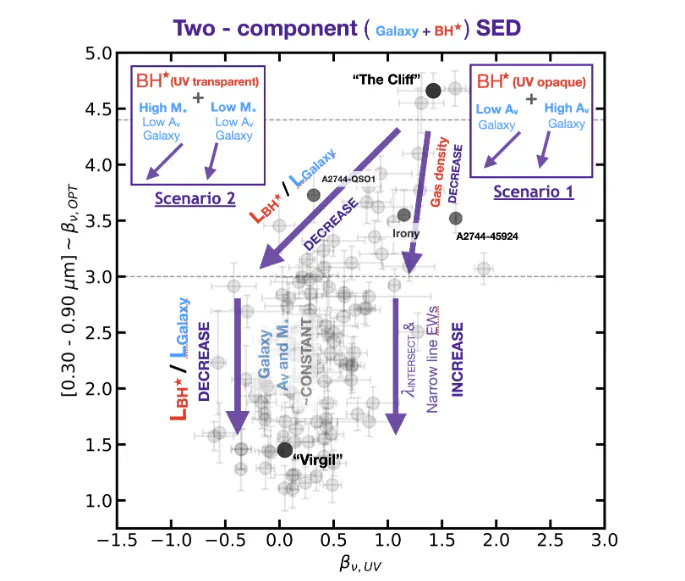 Diagnostic diagram for the two scenarios of LRDs
Abstract
One of JWST’s most unexpected discoveries is the emergence of ``Little Red Dots’ (LRDs), compact sources at z {\ensuremath{\gtrsim}} 3 with blue rest-frame UV continua, red optical slopes, and broad Balmer emission lines that challenge standard models and suggest early, unusual active galactic nuclei (AGNs). Using a comprehensive photometric selection and public NIRSpec/PRISM spectroscopy across six JWST deep fields, we identify a large sample of 118 LRDs with high-signal-to-noise-ratio spectra, enabling a population-wide analysis of their UV─optical continuum and lines. We find clear correlations between rest- frame UV─optical color ([0.3{\ensuremath{-}}0.9 {\ensuremath{\mu}}m]) and slopes; bluer LRDs have blue UV slopes ({\ensuremath{\beta}}$_{{\ensuremath{\nu}},UV}$ {\ensuremath{\sim}} 0.3) and red optical slopes, while redder LRDs exhibit redder UV slopes ({\ensuremath{\beta}}$_{{\ensuremath{\nu}},UV}$ {\ensuremath{\sim}} 1.1). The continuum shape shows a similar trend; redder LRDs display prominent Balmer breaks and curvature, while bluer LRDs follow power-law-like optical spectral energy distributions. From literature compilations, {\ensuremath{\sim}}60% of known broad-line AGNs satisfy our LRD criteria, and up to 90% of LRDs show broad Balmer lines. Emission line diagnostics reveal a shift from high H{\ensuremath{\alpha}}/H{\ensuremath{\beta}} and low [O III]{\ensuremath{\lambda}}5007/H{\ensuremath{\beta}} in redder LRDs to the opposite in bluer ones, along with stronger narrow- line equivalent widths, suggesting a transition from AGN- to host-dominated emission. We fit the spectra with a two-component model combining a gas-enshrouded black hole (BH) and a galaxy host. Redder LRDs require higher-luminosity, unreddened BHs and modestly reddened hosts; bluer LRDs require lower-luminosity, reddened BHs and dust-free galaxies. This framework reproduces the diversity in colors and spectral shape by varying BH luminosity, obscuration, and BH-to-host luminosity ratio.
Type
Publication
The Astrophysical Journal