The early maturity of high-redshift galaxies: Insights from sSFR, M/L, and SFHs at z ∼ 7─14
Jun 17, 2026·,,,,,,,,,,,,,,,,,,,,,, ,,·
0 min read
Paola Santini
Marco Castellano
Antonello Calabrò
Adriano Fontana
Emiliano Merlin
Davided Bevacqua
Pietro Bergamini
Médéric Boquien
Sebastiano Cantaerlla
Laure Ciesla
Andrea Ferrara
Steven L. Finkelstein
Flaminia Fortuni
Giovanni Gandolfi
Thomas Gasparetto
Emanuele Giallongo
Norman Grogin
Silvia T. Guida
Anton M. Koekemoer
Nicola Menci
Lorenzo Napolitano
Diego Paris
Laura Pentericci
Dr. Borja Pérez-Díaz
Bozhidara Stoyanova
Tommaso Treu
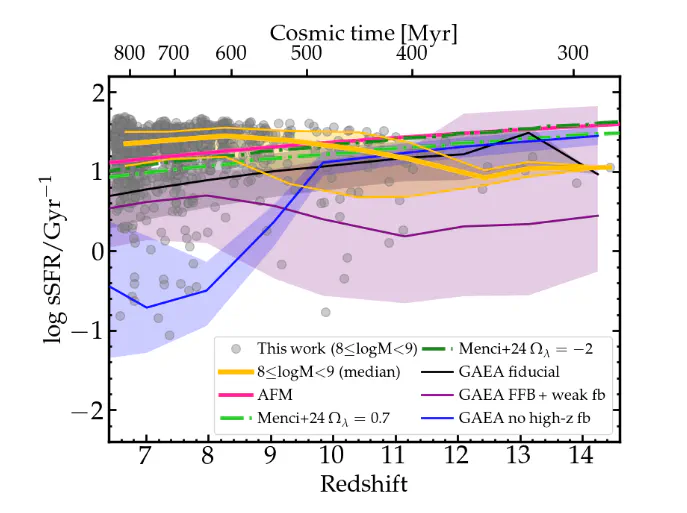 Evolution of the specific star formation rate as a function of redshift
Abstract
The James Webb Space Telescope (JWST) has revealed an unexpected excess of UV-bright galaxies at z > 10, unaccounted for by extrapolations from pre-JWST observations and theoretical models. Understanding the physical properties and star formation histories (SFHs) of high-redshift systems is key to distinguishing between the different proposed scenarios and assessing their implications for the galaxy formation and evolution picture. We identified and analysed a sample of 2420 robust candidates at z {\ensuremath{\sim}} 7 {\ensuremath{-}} 14 drawn from the ASTRODEEP-JWST dataset over {\ensuremath{\sim}}0.2 deg$^{2}$, and modelled their properties with non-parametric SFHs to derive the specific star formation rate (sSFR) and stellar population properties. We find that the median sSFR and M/L remain roughly constant across the probed redshift range. We show that this result is robust against potential systematics unless a hidden population of dust- enshrouded starbursts, undetectable in the current data, exists at these redshifts. In any case, the absence of observed high- sSFR systems at the highest redshifts suggests that any dust- free starburst phase must be short-lived. The observed sSFR evolution is in tension with most (though not all) theoretical models, making it a key quantity for discriminating among competing scenarios. The sample shows a wide range of physical conditions and galaxy classes, including systems with low sSFRs and high mass-to-light ratios (M/L) up to z {\ensuremath{\sim}} 10, indicative of already-evolved galaxies only a few hundred megayears after the Big Bang, and different degrees of dust attenuation. We finally reconstructed the assembly histories of two sub-samples, namely the highest-M/L galaxies at z {\ensuremath{\sim}} 7 {\ensuremath{-}} 8, which appear to have formed the bulk of their stars at least 500 Myr before observation, implying progenitors observable as UV-bright sources at z > 20, and the full sample of z > 11 galaxies, which formed through stochastic SFHs, remaining UV-faint for most of their early evolution, before undergoing recent ({\ensuremath{\sim}}50 Myr old) episodes of major growth.
Type
Publication
Astronomy & Astrophysics