Andromeda's tenuous veil: A likely Milky Way nebula projected toward M31
Dec 16, 2025·,,,, ,,,,,,,·
0 min read
Alejandro Lumbreras-Calle
Juan A. Fernández-Ontiveros
Raúl Infante-Sainz
Mohammad Akhlaghi
Borja Montoro-Molina
Dr. Borja Pérez-Díaz
Andrés Del Pino
Hector Vives-Arias
Antonio Hernán-Caballero
Carlos López-Sanjuan
Martín A. Martín-Guerrero
Sepideh Eskandarlou
Alessandro Ederoclite
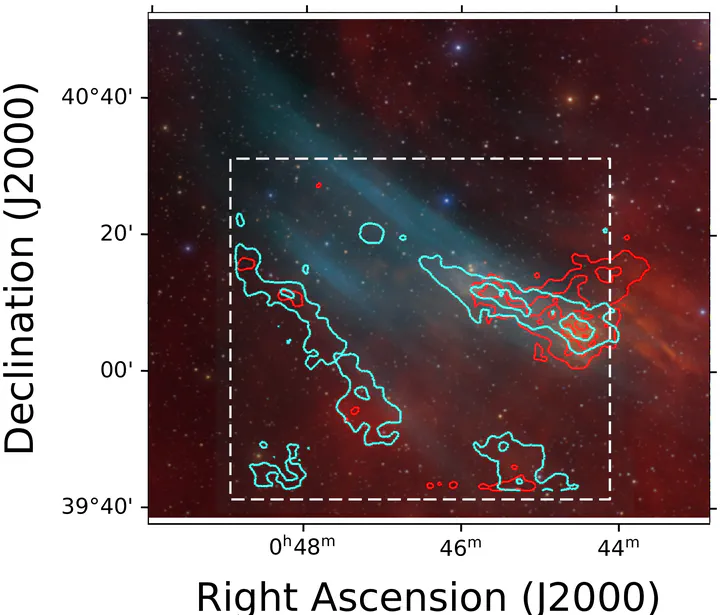 Contours of emission in the JAST80 observations on the nebula, for [O II] (filter J0378) in cyan, and for H_alpha in red (filter J0660)
Abstract
Context. A large, faint nebula was unexpectedly discovered near M31 using narrowband [O III] images. Its apparent size and the lack of a clear counterpart at other wavelengths make it unique and challenging to explain. Aims. We aim to determine whether the nebula is extragalactic and vast or associated with the Milky Way filamentary structure. This will enable us to constrain its physical properties and assess its nature. Methods. We obtained deep narrowband [O II]3727 and Ha+[NII] observations with the JAST80 telescope at the Observatorio Astrofísico de Javalambre, as well as high spectral resolution spectroscopy (R ~ 5000) at four locations within the region of interest using the MEGARA integral field unit at the Gran Telescopio Canarias. Results. We found extended [O II] emission along two near-parallel strands to the [O III], offset by six arcmin. The nebular spectra reveal up to six emission lines from [O III]4959,5007, Hb, [N II]6583, and [S II]6716,6731. Their receding velocities are above -40 km/s, far from the systemic velocity of M31 (-300 km/s ). The fluxes and velocities are remarkably consistent for the same lines across different regions of the nebula. Conclusions. The nebular properties suggest a location within the Milky Way rather than being physically associated with M31. The most likely scenario suggests a resolved ionization structure in a Galactic nebula with a separation between [O II] and [O III] on the order of a few parsecs. The observed receding velocities would be unprecedented for an object physically linked to M31 but are common for nearby gas filaments. Their consistency across the nebula would also be highly unusual if it were larger than a kiloparsec. The analysis of the emission line ratios, line widths, and morphology suggests the possibility of it being an interstellar gas filament with an additional source of ionization to explain the [O III] emission. However, the complex properties of this object call for further observations to confirm its nature.
Type
Publication
Astronomy & Astrophysics