
TRICEPS - Tracing Rotation with Ionized Carbon in Early Primeval Systems
TRICEPS is a survey of 15 massive galaxies at z=4-5, when the Universe was less than 1.5 Gyr old. TRICEPS combines new observations from ALMA, JWST, and the VLA, as well as ancillary data from HST, Spitzer, and Herschell.
Jul 1, 2025

Estallidos
ESTALLIDOS is a coordinated project between several Spanish research centers to study the formation and evolution of outbursts of star formation. The project is aimed at studying massive starbursts and their impact on galaxies, using both observational and theoretical tools. We observe starbursts and model the physical processes that are involved, paying particular attention to the feedback on the surroundings that quenches or stimulates the formation of successive generations of stars. The project began in December 2001, in a collaboration among astronomers from the LAEFF (Madrid; currently integrated into the CAB ), the VILSPA (Madrid, currently ESAC ), the IAA (Granada), and the IAC (Canary Islands) funded by the Spanish Plan Nacional de Astronomía y Astrofísica ( AYA2001-3939-C03 ). From the beginning, the project has involved the participation of researchers from all over the world. In later editions, UAM , and, posteriorly CIEMAT (Madrid) joined the project. Details about the different funded projects can be found in the Organization Chart and Operations item in the left menu. Now we are in the eighth edition: ESTALLIDOS 8 : Las diversas facetas de la formación estelar en el Universo (PID2022-136598NB-C31, C32 and C33) which is coordinated by the IAC node. The project is organized and coordinated through workshops in which ongoing work is discussed and new results are presented. They are attended by a significant part of the Estallidos community ( currently around 60 ) and help to maintain strong scientific bounds and close collaborations.
Feb 1, 2021
AGN-EHE
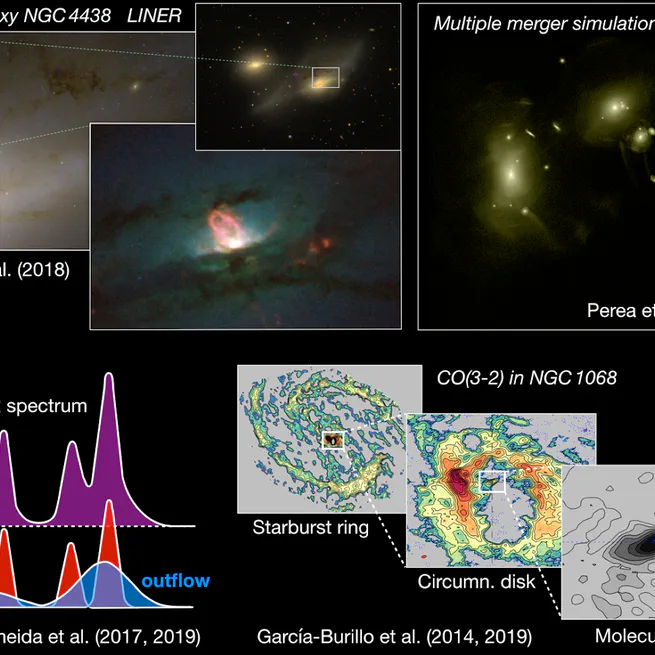
The aim of this collaboration is to bring together four groups of researchers with proved expertises and skills and with important national and international collaborations in different areas of the AGN phenomenon - covering a large range of intrinsic luminosities (from LINERs to QSOs), low to high accretion rates, distances close to the BH to galactic and cluster scales, low to high redshift - and from the perspective of both statistical and/or detailed analysis of observational data and numerical simulations. The topics we plan to address include how SMBHs grow, the connection between BH low and high accretion systems, the role played by obscuration in AGNs, and the study of star formation and nuclear activity in lenticular galaxies, and AGN feeding and feedback. The final goal is consolidating a scientifically strong group to address the challenges in the research frontier of AGNs and their connection with galaxy formation and evolution, where we expect to go on making significant contributions.
Feb 1, 2021
HII-CHI-Mistry
HII-CHI-Mistry is a collection of python subroutines aimed at the calculation of chemical abundances and physical properties using emission line fluxes from ionised gaseous nebulae.
Sep 1, 2020