Contribution of very massive stars to the sulfur abundance in star-forming galaxies: Role of pair-instability supernovae
May 1, 2024·, ,,,·
0 min read
,,,·
0 min read
S. Goswami
J. M. Vílchez
Dr. Borja Pérez-Díaz
L. Silva
A. Bressan
E. Pérez-Montero
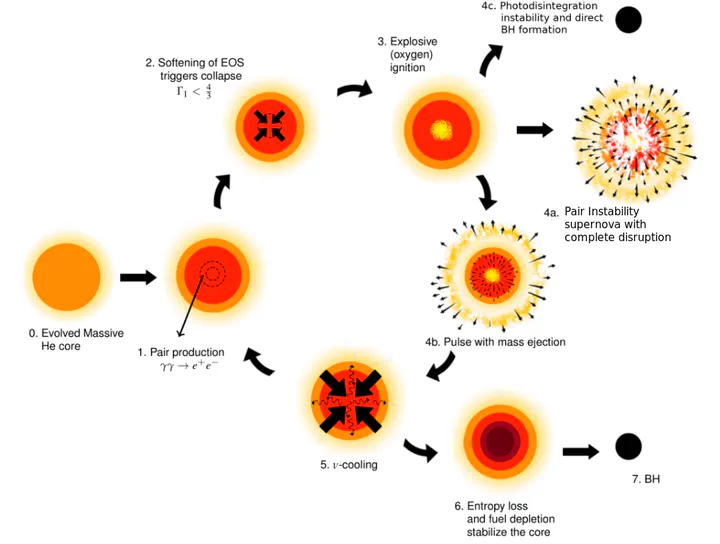 Cartoon representing the core evolution through (P)PISN (see Renzo et al. (2020, 2024) for more details)
Abstract
Context. Recent work presented increasing evidence of high non-constant S/O abundance ratios observed in star-forming metal-poor galaxies that deviated from the constant canonical S/O across a wide range of O/H abundances. Similar peculiarly high Fe/O ratios have also recently been detected. Aims: We investigate whether these high S/O ratios at low metallicities could be explained when the process of pair-instability supernovae (PISN) in chemical modelling is included, through which a similar behaviour of the Fe/O ratios was reproduced successfully. Methods: We used chemical evolution models that considered the stages of PISN in the previously published yields and adopted a suitable initial mass function (IMF) to characterize this evolutionary stage appropriately. Results: The peculiarly high values and the behaviour of the observed S/O versus O/H relation can be reproduced when the ejecta of very massive stars that go through the process of PISN are taken into account. Additionally, a bimodal top-heavy IMF and an initial strong burst of star formation are required to reach the reported high S/O values. Conclusions: We show that the role of very massive stars going through the process of PISN should be taken into account to explain the chemical enrichment of sulphur and oxygen in metal-poor star-forming regions.
Type
Publication
Astronomy & Astrophysics