SOFIA Observations of Far-IR Fine-structure Lines in Galaxies to Measure Metallicity
Feb 1, 2022·,,,, ,,,,,·
0 min read
,,,,,·
0 min read
Luigi Spinoglio
Juan Antonio Fernández-Ontiveros
Matthew A. Malkan
Suyash Kumar
Miguel Pereira-Santaella
Dr. Borja Pérez-Díaz
Enrique Pérez-Montero
Alfred Krabbe
William Vacca
Sebastian Colditz
Christian Fischer
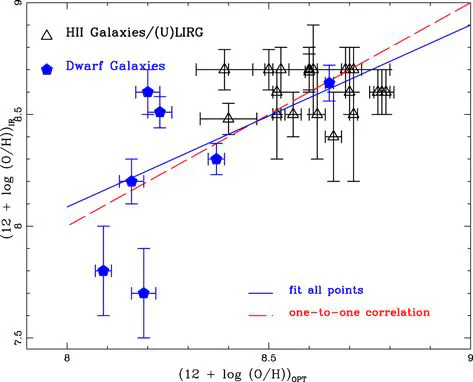 Optical vs infrared estimations of 12+log(O/H)
Abstract
We present new and archival SOFIA FIFI-LS far-IR spectroscopic observations of the [O III] 52 ensuremathμm and/or the [N III] 57 ensuremathμm lines of 25 local galaxies. Including 31 other galaxies from Herschel-PACS, we discuss a local sample of 47 galaxies, including the H II galaxies, luminous IR galaxies, low-metallicity dwarfs, and Seyfert nuclei. Analyzing the mid- to far-IR fine-structure lines of this sample, we assess the metallicity and compare it with the optical spectroscopy estimates. Using the IR, we find an O/H-N/O relation similar to that known in the optical. Conversely, we find systematically lower N/O IR abundances when compared to the optical determinations, especially at high values of N/O ( ?tex tbackslashmathrmlog(m̊N/textbacksla shrmO) $ -0.8). We explore various hypotheses to account for this difference: (i) difference in ionization structure traced by optical (O+, N+ regions) versus IR lines (O2+, N2+ regions), (ii) contamination of diffuse ionized gas affecting the optical lines used to compute the N/O abundance, and (iii) dust obscuration affecting the optical-based determinations. However, we have not found any correlation of ?̊Δ (rN̊/rm̊)=( rm̊/rmO)̊_mathrmOPT-(rmN̊rmO_̊mathrm IR$ with ionization, or electron density, or optical extinction. We speculatively suggest that the accretion of metal-poor gas from the circumgalactic medium could provide an explanation for this difference because the rapid decrease of total abundances during infall is followed by a N/O ratio decrease due to the primary production of young-possibly embedded-massive stars, which are preferentially traced by the IR diagnostics, while optical diagnostics would better trace the secondary production, when both N/O and O/H abundance ratios increase.
Type
Publication
The Astrophysical Journal